Showing posts with label Muhammad Yunus. Show all posts

Thursday, February 5, 2009

muhammad yunus


Professor Muhammad Yunus established the Grameen Bank in Bangladesh in 1983, fueled by the belief that credit is a fundamental human right. His objective was to help poor people escape from poverty by providing loans on terms suitable to them and by teaching them a few sound financial principles so they could help themselves.

From Dr. Yunus' personal loan of small amounts of money to destitute basketweavers in Bangladesh in the mid-70s, the Grameen Bank has advanced to the forefront of a burgeoning world movement toward eradicating poverty through microlending. Replicas of the Grameen Bank model operate in more than 100 countries worldwide.

Born in 1940 in the seaport city of Chittagong, Professor Yunus studied at Dhaka University in Bangladesh, then received a Fulbright scholarship to study economics at Vanderbilt University. He received his Ph.D. in economics from Vanderbilt in 1969 and the following year became an assistant professor of economics at Middle Tennessee State University. Returning to Bangladesh, Yunus headed the economics department at Chittagong University.

From 1993 to 1995, Professor Yunus was a member of the International Advisory Group for the Fourth World Conference on Women, a post to which he was appointed by the UN secretary general. He has served on the Global Commission of Women's Health, the Advisory Council for Sustainable Economic Development and the UN Expert Group on Women and Finance.

Professor Yunus is the recipient of numerous international awards for his ideas and endeavors, including the Mohamed Shabdeen Award for Science (1993), Sri Lanka; Humanitarian Award (1993), CARE, USA; World Food Prize (1994), World Food Prize Foundation, USA; lndependence Day Award (1987), Bangladesh's highest award; King Hussein Humanitarian Leadership Award (2000), King Hussien Foundation, Jordan; Volvo Environment Prize (2003), Volvo Environment Prize Foundation, Sweden; Nikkei Asia Prize for Regional Growth (2004), Nihon Keizai Shimbun, Japan; Franklin D. Roosevelt Freedom Award (2006), Roosevelt Institute of The Netherlands; and the Seoul Peace Prize (2006), Seoul Peace Prize Cultural Foundation, Seoul, Korea. He is a member of the board of the United Nations Foundation.


Thursday, January 29, 2009

Banker to the poor


Professor Muhammad Yunus established the Grameen Bank in Bangladesh in 1983, fueled by the belief that credit is a fundamental human right. His objective was to help poor people escape from poverty by providing loans on terms suitable to them and by teaching them a few sound financial principles so they could help themselves.

From Dr. Yunus' personal loan of small amounts of money to destitute basketweavers in Bangladesh in the mid-70s, the Grameen Bank has advanced to the forefront of a burgeoning world movement toward eradicating poverty through microlending. Replicas of the Grameen Bank model operate in more than 100 countries worldwide.

Born in 1940 in the seaport city of Chittagong, Professor Yunus studied at Dhaka University in Bangladesh, then received a Fulbright scholarship to study economics at Vanderbilt University. He received his Ph.D. in economics from Vanderbilt in 1969 and the following year became an assistant professor of economics at Middle Tennessee State University. Returning to Bangladesh, Yunus headed the economics department at Chittagong University.

From 1993 to 1995, Professor Yunus was a member of the International Advisory Group for the Fourth World Conference on Women, a post to which he was appointed by the UN secretary general. He has served on the Global Commission of Women's Health, the Advisory Council for Sustainable Economic Development and the UN Expert Group on Women and Finance.

Professor Yunus is the recipient of numerous international awards for his ideas and endeavors, including the Mohamed Shabdeen Award for Science (1993), Sri Lanka; Humanitarian Award (1993), CARE, USA; World Food Prize (1994), World Food Prize Foundation, USA; lndependence Day Award (1987), Bangladesh's highest award; King Hussein Humanitarian Leadership Award (2000), King Hussien Foundation, Jordan; Volvo Environment Prize (2003), Volvo Environment Prize Foundation, Sweden; Nikkei Asia Prize for Regional Growth (2004), Nihon Keizai Shimbun, Japan; Franklin D. Roosevelt Freedom Award (2006), Roosevelt Institute of The Netherlands; and the Seoul Peace Prize (2006), Seoul Peace Prize Cultural Foundation, Seoul, Korea. He is a member of the board of the United Nations Foundation.

Wednesday, January 28, 2009

“Profit should not be the only reason that businesses exist…”- Muhammad Yunus

Muhammad Yunus, a Bangladesh banker and economist, was the one who developed the concept of microcredit. He gives loans in small rates for those people who want to create business but doesn’t have enough money. He built the Grameen Bank in 1983 to make loans for the poor in Bangladeshis.

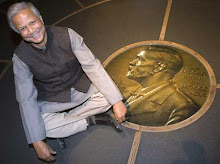
The main intention of his bank is to lend money for the people who had nothing. Traditional banks, do not want the concept of having small loans with a low interest rate, for they are afraid that they might not be repaid. Yunus, on the other hand believed that the poor would repay the money that they borrowed. M.Y, did not failed on doing this, the Grameen Bank he established received a Noble Peace Prize award in 2006, because of his efforts to improve the economy through social entrepreneurship.

“It is a company which is focused on the social good and which makes a profit, but it is not focused on maximizing its profits. I am not interested in turning all profit-oriented companies into socially conscious operations. They are two different categories of companies -- there will always be businesses whose primary goal is that of earning as much money as possible. That is okay. But earning as much money as possible can only be a means to an end, not an end in itself. One has to invest money in something meaningful -- and I would make a case for it being something that improves the quality of life for all people.” Dr. Yunus said this on one of interviews in Spiegel Online.

Truly, Dr. Yunus helped a lot of people. He believed that the poor doesn’t ask for charity and charity is not the solution to poverty. He does not only do business just to maximize profits like other companies do. There’s a need for a lot of companies who do not only focuses on the profits they are earning, but that of providing greatest benefits for human kind.

Muhammad Yunus: A Nobel laureate Banker envisions an end to poverty

Article by Ishaan Tharoor

In 1974, famine gripped Bangladesh. Hundreds of thousands died and millions became destitute. "Villagers had to borrow loan sharks on terrible conditions," says Muhammad Yunus, "and some even became slave labor for the money lenders." For Yunus, who had just returned to Bangladesh as an economics professor after completing his Ph.D. in the U.S., it was wrenching to discover how meaningless his academic achievements were in the midst of all this suffering. Hoping to cure his own sense of helplessness, he wandered the muddy lanes of a village next to his university, searching for ways to help. Little did he know that this nervouse exploration would plant the seeds of an economic miracle still blooming decades later.

Yunus compiled a list of the village's 42 most impoverished and went about repaying each of their debts for a paltry total of $27. While banks would never lend money to these ofther illiterate and undocumented peasants. Yunus simply asked that they work hard and repay him "when they could." He recalls: "It was a big shock that just a little money could make people so happy. With the money they could become free."

This is the operating ethos of the Grameen Bank, which Yunus founded in 1983 and which has since extended microloans to 6.6 million people in Bangladesh, most of them women. "Conventional banks look for the rich," says Yunus. "We look for the absolutely poor." As Yunus sees it, credit is a human right, enabling a person "to unwrap that gift of one's self and find out who he is." Yet the concept he pioneered has proved to be much more than kind-hearted charity: 99% of Grameen's borrowers repay their debts --despite the fact that they borrow without providing collateral -- and the bank makes a modest profit.

Inspired by his success, many others have embraced Yunus' concept. From the U.S. to Uganda, over 100 million people are now enrolled in various microedit schemes. Prominent global figures otherwise at each otehr's throarts, such as Paul Wolfowitz, head of the World Bank, and Hugo Chavez, the leftist President of Venezuela, have all praised Yunus' achievement. And, on Oct. 13, Yunus received the most extraordinary endorsement yet, becoming the first businessman ever to win the Nobel Prize for Peace. As the news broke, his entire country celebrated. Prime Ministed Khaleda Zia heralded him as "the pride of Bangladesh," while thousands flocked to Grameen's headquarters in the suburbs of Dhaka to congratulate their hero.

For Yunus --whose father struggled to support 10 children as the owner of a tiny ornaments shop in the City of Chittagong --the Nobel is an almost unimaginable accomplishment. But his ambitions are far bolder than this. Yunus insists it's possible to eradicate global poverty within two generations with microedit uplifting countless millions. "At the rate we're heading, we'll halve total poverty by 2015," he says. "We'll create a poverty museum in 2030."

Reference: www.time.com